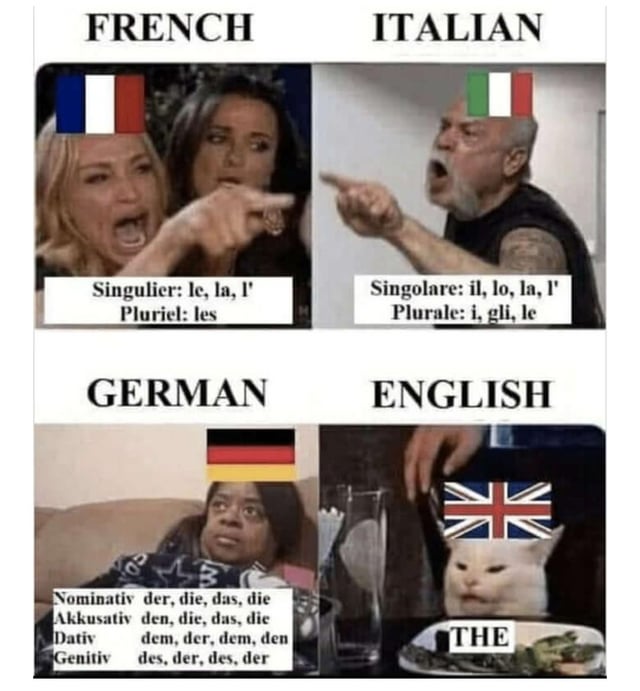
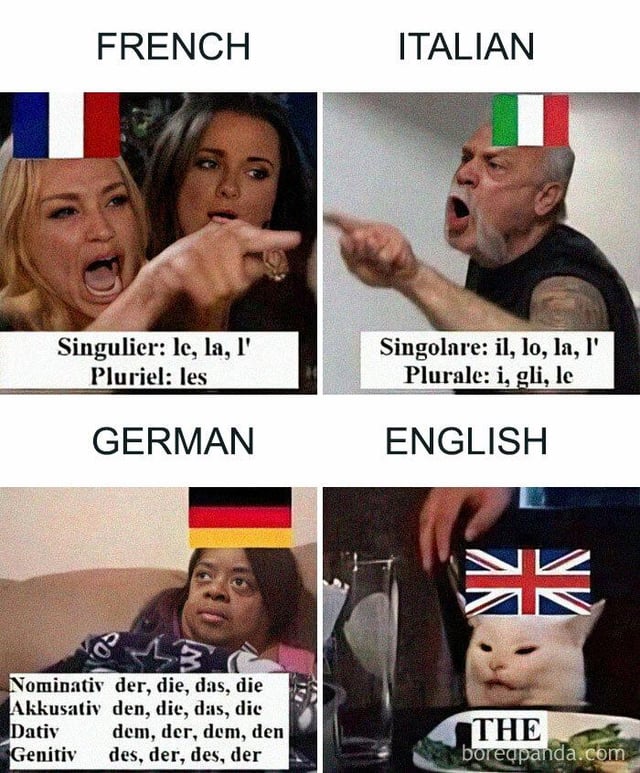
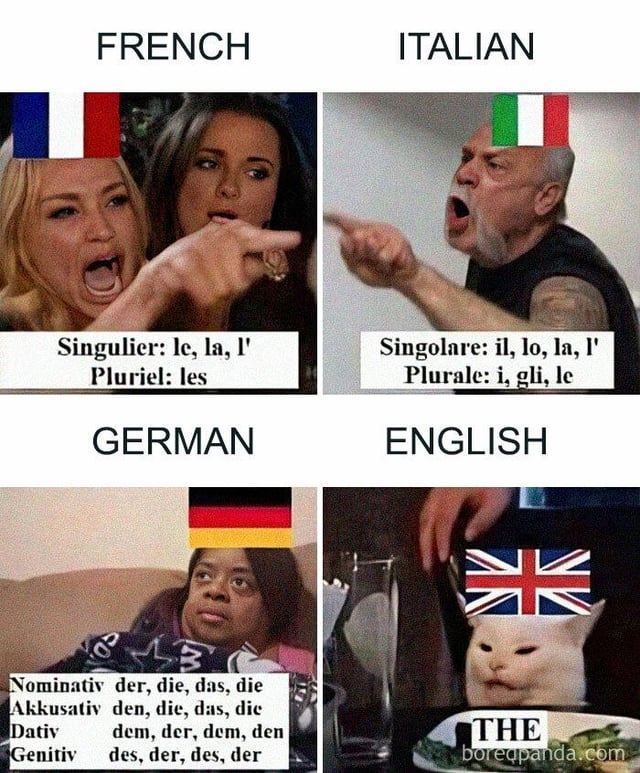
ENGLISH??? Definite Article Grammar Comparison Meme
Text content
Comparison of definite article rules across French, Italian, German, and English
Overview
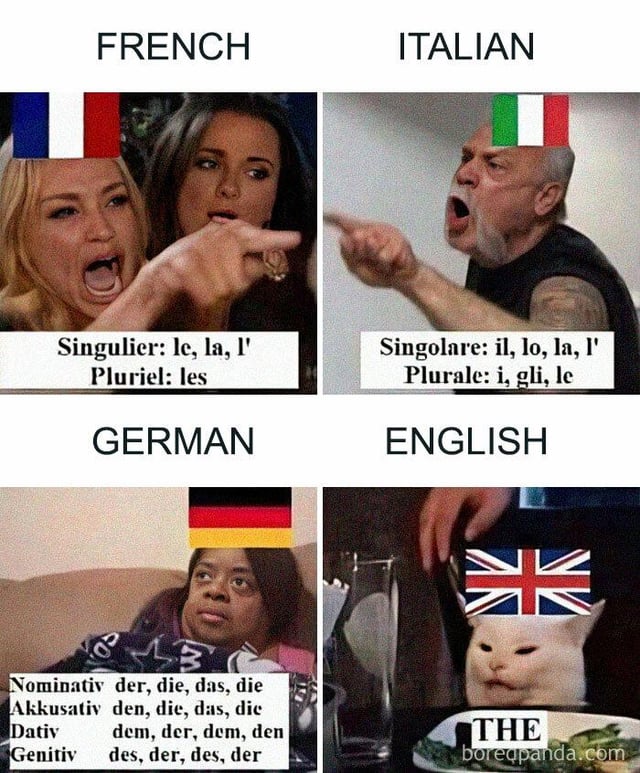
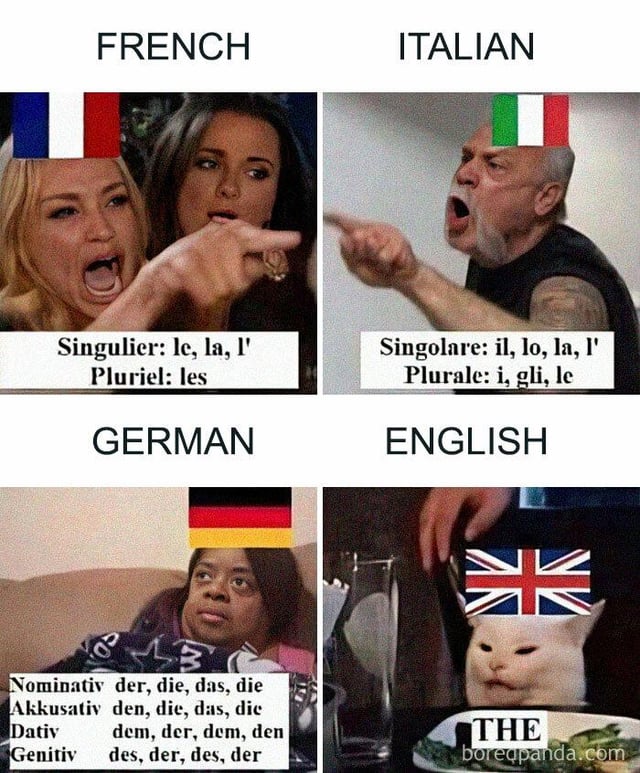
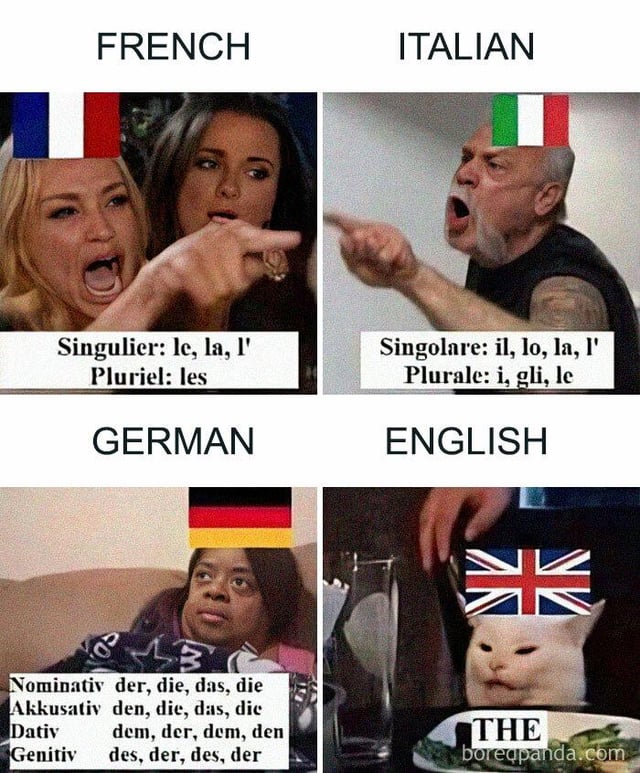
This is a 4-panel comparison meme that jokes about the relative complexity of definite article grammar rules across four European languages: French, Italian, German, and English. Each panel is labeled with a language name, paired with the corresponding national flag, a classic reaction meme character, and the list of definite articles for that language. The French panel shows two yelling, pointing women from the Real Housewives franchise, with text listing French singular articles (le, la, l') and plural article (les). The Italian panel features the yelling, pointing Paul Teutul Sr. from American Chopper, listing Italian singular (il, lo, la, l') and plural (i, gli, le) articles. The German panel shows a confused young woman looking upward, with a long list of German definite articles across four grammatical cases (nominative, accusative, dative, genitive) with multiple gender and number variations. The final English panel features Smudge the Confused Cat from the popular 'Woman Yelling at Cat' meme, with only the single definite article 'THE' listed. The joke highlights that English has only one universal definite article, making it far simpler in this aspect compared to the other three languages, which have multiple articles determined by gender, number, and/or grammatical case.
Origin notes
This meme is a derivative work combining multiple popular reaction meme formats, centered on the widely recognized 'Woman Yelling at Cat' template. It was originally shared on Reddit under the title 'ENGLISH???' as stated in the provided source information, and was also republished on Bored Panda, as indicated by the boredpanda.com watermark on the bottom right panel. It circulates widely in language learning, linguistics, and general humor communities, playing on the common frustration learners feel with complex grammatical gender and case rules in many European languages.