This Week In Science Roundup from Science Alert

Text content
This Week In Science
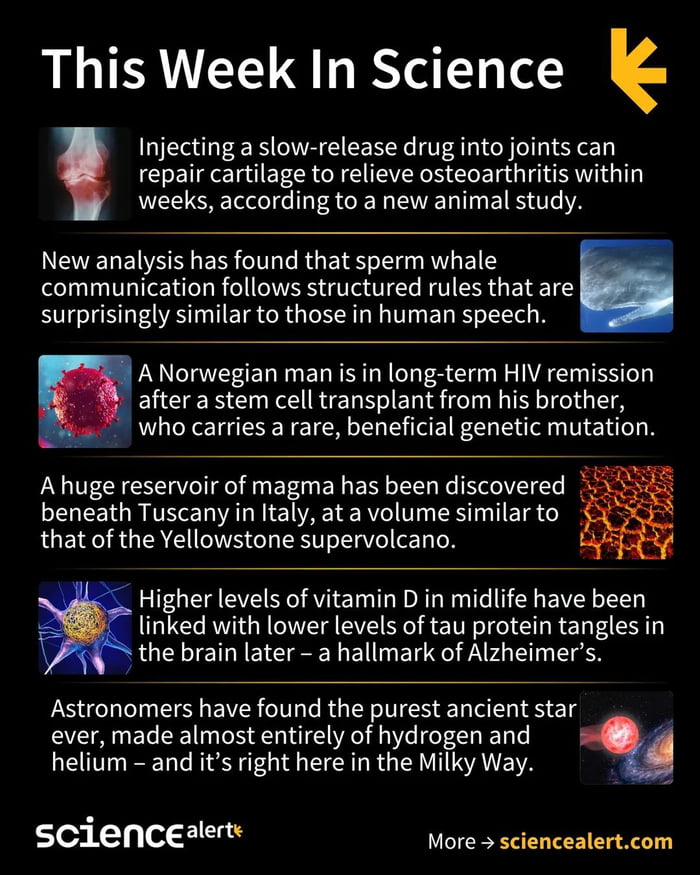
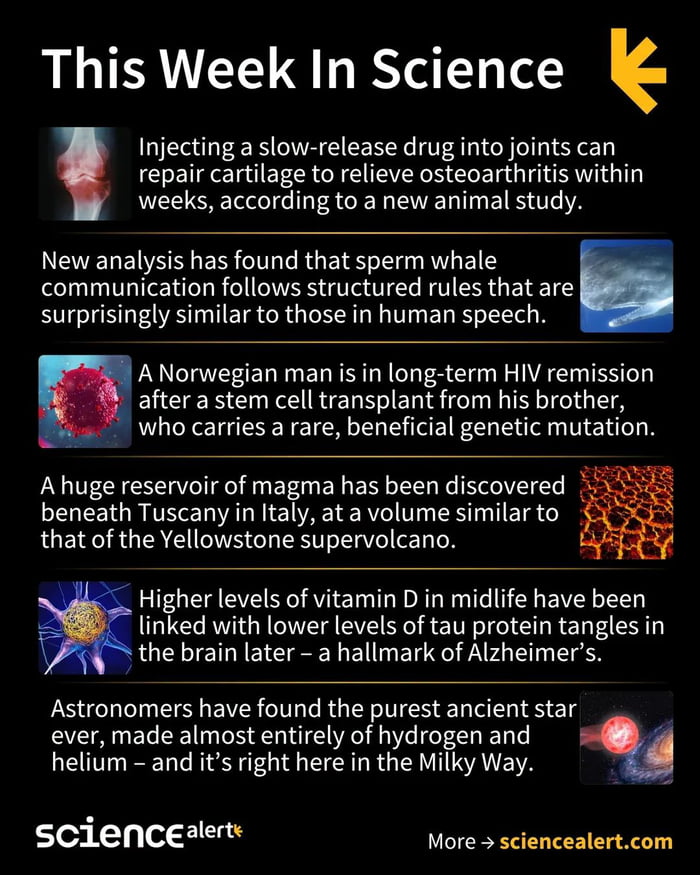
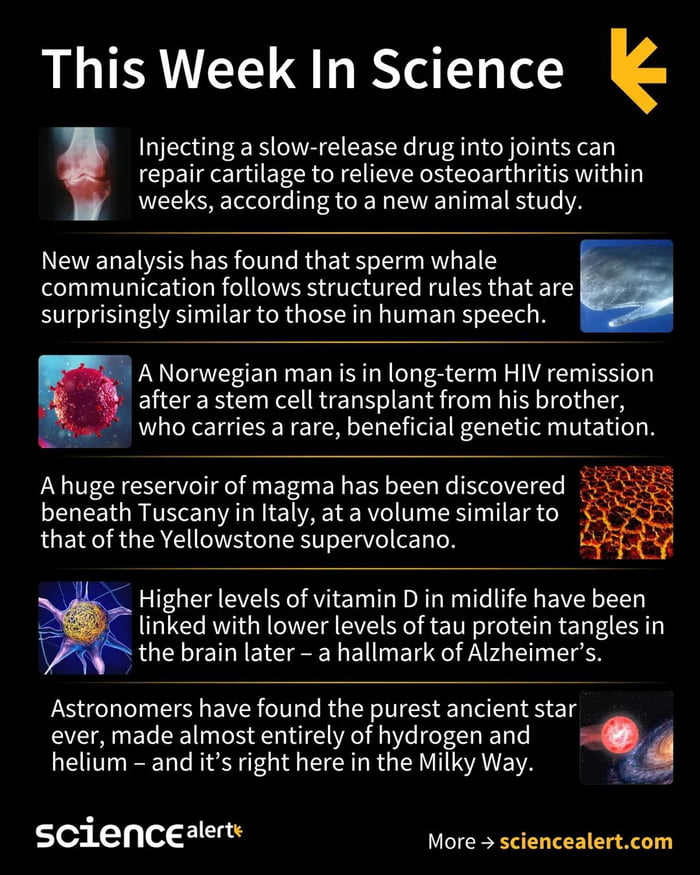
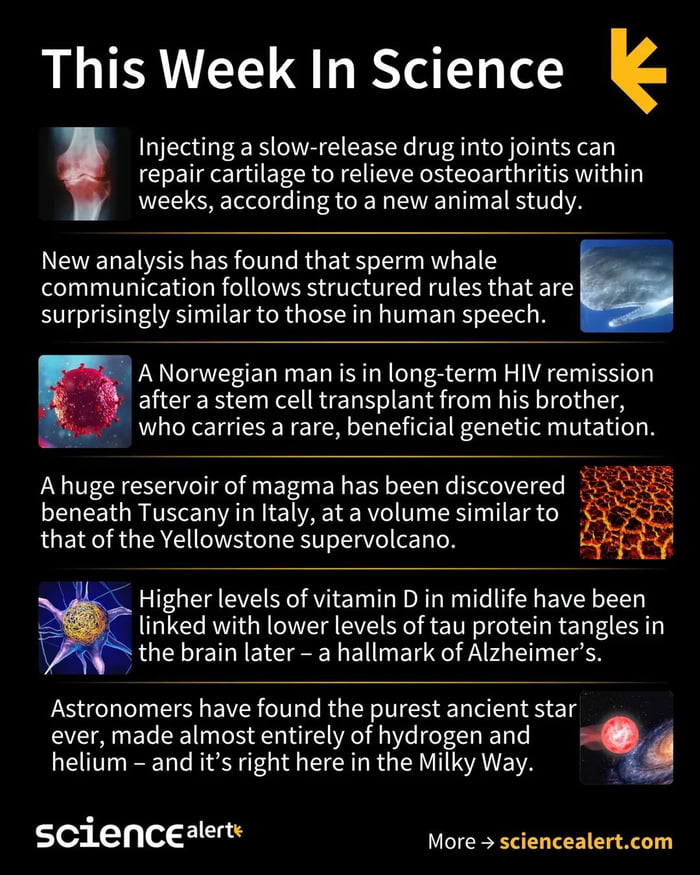
1. Injecting a slow-release drug into joints can repair cartilage to relieve osteoarthritis within weeks, according to a new animal study.
2. New analysis has found that sperm whale communication follows structured rules that are surprisingly similar to those in human speech.
3. A Norwegian man is in long-term HIV remission after a stem cell transplant from his brother, who carries a rare, beneficial genetic mutation.
4. A huge reservoir of magma has been discovered beneath Tuscany in Italy, at a volume similar to that of the Yellowstone supervolcano.
5. Higher levels of vitamin D in midlife have been linked with lower levels of tau protein tangles in the brain later – a hallmark of Alzheimer’s.
6. Astronomers have found the purest ancient star ever, made almost entirely of hydrogen and helium – and it’s right here in the Milky Way.
Overview
This is an infographic with a solid black background, published as part of Science Alert's 'This Week In Science' series. It lists 6 recent peer-reviewed scientific findings, each paired with a small illustrative thumbnail: 1) A slow-release joint injection that repairs cartilage to relieve osteoarthritis in weeks, per new animal study (thumbnail of an inflamed knee joint). 2) Sperm whale communication follows structured rules highly similar to human speech, per new analysis (thumbnail of a sperm whale). 3) A Norwegian man is in long-term HIV remission after receiving a stem cell transplant from his brother who carries a rare beneficial genetic mutation (thumbnail of an HIV virus particle). 4) A massive magma reservoir with volume comparable to the Yellowstone supervolcano was discovered under Tuscany, Italy (thumbnail of cracked, glowing magma). 5) Higher midlife vitamin D levels are linked to lower levels of tau protein tangles (a key Alzheimer's disease hallmark) in the brain later in life (thumbnail of a brain neuron). 6) Astronomers discovered the purest known ancient star, made almost entirely of hydrogen and helium, located within the Milky Way galaxy (thumbnail of the ancient star in space). The bottom of the graphic displays the Science Alert logo and a link to sciencealert.com for more information.
Origin notes
This infographic was originally created by Science Alert, a well-known independent science news publisher that covers recent research across all scientific fields. As specified in the provided additional information, this version of the infographic was shared on the 9Gag platform, under the original title 'Weekly science by science alert'. The infographic links viewers to Science Alert's official website for full details on each of the reported studies.